
Violin Making
Day 1 The plates
This is one page in a series about violin making by hand in the traditional way. Please see the introduction for more, and our violin making courses if you are inspired to make a violin yourself.

Today the wood for the violin is selected and the plates are prepared.
Violin maker Derek Roberts selects a piece of spruce for the front of the instrument from his store of seasoned wood. The store also contains pieces of maple which will be used for the back, ribs and scroll.
The excitement of making a violin is here in these pieces of wood. Beautiful in their own right, they will be fashioned by the hands of a master craftsman into a beautiful instrument which will in turn produce wonderful sounds in the hands of a master musician.


The wedge
of spruce as it was sawn from the tree. Spruce is strong and light
and has ideal resonant qualities.
A saw cut through the wedge allows it to be opened up like a book, into two plates. The two plates will eventually be glued together. First they have to be flattened and squared to make a perfect joint.

Derek uses a large plane to flatten the face of each plate.
He then planes the edges of each plate square.


Derek checks the edges with a square, and the faces with a straight edge. More work must be done with the plane until a perfect result is obtained. Then the two plates can be glued together.


Derek examines the joint before applying glue.
The two plates must fit together perfectly. The final joint will
be almost invisible. Hot animal glue is applied to the joint. Derek
rubs the two surfaces of the joint together to get rid of excess
glue.
Finally the plates are cramped together. The glue will take several hours to dry. Later, the outline of the front will be marked and roughly sawn out.
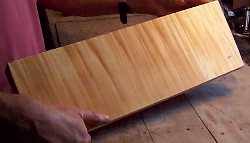
This wedge of maple will be prepared and jointed
in the same way, for the back of the violin. Maple selected for
violin making is often strikingly figured, as in this piece.
The flame, as the figuring is called,
appears to flicker as it catches the light from different angles.
This gives a very attractive effect to the finished instrument.
 |
In the next stage, Derek works on preparing and shaping the blocks. |
Are you interested in learning to make a violin, or developing your violin making skills? See our Violin Making Courses. Our resources page has recommendations for books and suppliers for violin making.
All material on this site © copyright Derek Roberts, Leamington Spa 1999, 2000, 2001, 2014